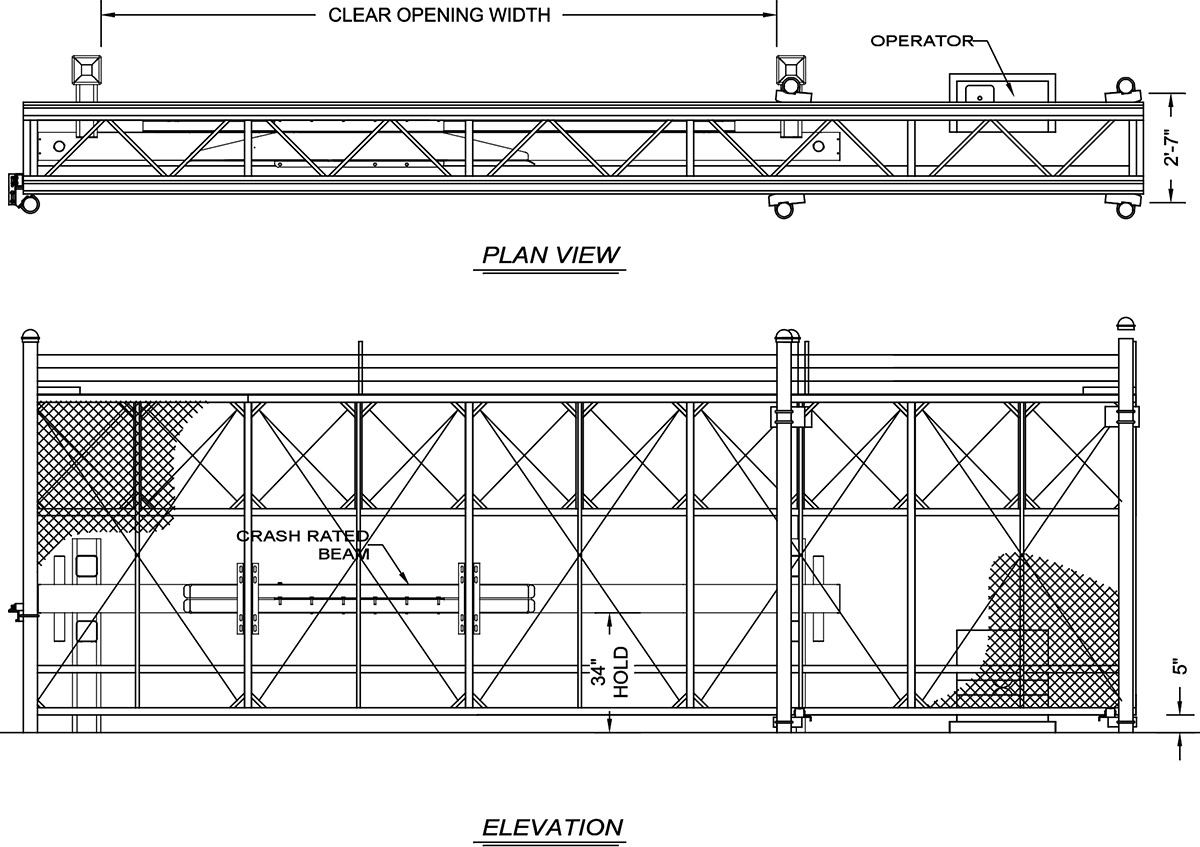
Commercial Crash-Rated Barriers
To determine the best perimeter security option for a site, conduct a thorough risk assessment to identify where vulnerabilities may exist and how that compares to the sites’ security objectives. A TYMETAL specialist is always available to help you choose perimeter security solutions that best fit the site’s unique requirements and characteristics.

Understanding Crash Ratings
It is important to understand Crash Test Standards before selecting a crash rated vehicular barrier. Please read our Guide to Understanding Crash Ratings and refer to the Crash Test Matrix below.
Most Commonly Used Crash Test Ratings (and how they relate to each other)
| Crash Test Standard | US DoS SD-STD-02.01 (1985) | US DoS SD-STD-02.01 Rev. A (2003) | ASTM F2656-20 (2007-current) | BSI (British Standards Institution) – PAS 68 & IWA 14 |
|---|---|---|---|---|
| Test Vehicle | 15,000 lb Medium Duty Truck | 15,000 lb Medium Duty Truck | 15,000 lb Standard Test Truck (M) | PAS 68 – 7,500 kg (16,535 lb) Cab-over Engine Medium Duty Truck IWA 14 – 7,200 kg (15,873 lb) Cab-over Engine Medium Duty Truck |
| Test Vehicle Speed | K4 = 30 mph K8 = 40 mph K12 = 50 mph | K4 = 30 mph K8 = 40 mph K12 = 50 mph | M30 = 30 mph M40 = 40 mph M50 = 50 mph | 48 kph = 30 mph 64 kph = 40 mph 80 kph = 50 mph |
| Penetration Ratings | L3 = less than or equal to 3 ft L2 = greater than 3 ft – 20 ft L1 = greater than 20 ft – 50 ft | Must be less than or equal to 1 m | P1 = less than or equal to 1 m (3.3 ft) P2 = 1.01 m – 7 m (3.31 ft – 23 ft) P3 = 7.01 m – 30 m (23.1 ft – 98.4 ft) | Penetration distance of both vehicle and debris field are given in the classification (see interpretation below). |
| Examples | K12 (L2) – Rated to stop a 15,000 lb truck traveling 50 mph with a penetration between 3 ft and 20 ft. | K4 – Rated to stop a 15,000 lb truck traveling at 30 mph with a penetration of less than or equal to 1 m. | M40 (P3) – Rated to stop a 15,000 lb truck traveling at 40 mph with a penetration between 7.01 m and 30 m. | How to read PAS 68 classification code (see graphic below this table*). |
*Interpreting the PAS 68 Classification Code
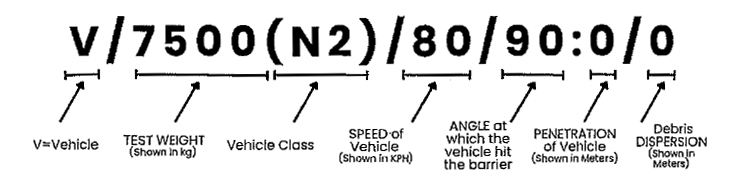
* IWA 14 does not consider debris dispersion.
Crash-Rated Barriers



Frequently Asked Questions
TYMETAL has been in the perimeter security solutions market since 1985. With more than three decades of experience designing, manufacturing, and installing Crash-Rated Barriers, we have encountered many questions along the way. Explore a few of the common questions we are asked below. If you don’t find the answers you’re looking for, feel free to contact us by phone at 888-978-4283 or online.
What types of crash-rated barriers does TYMETAL offer?
TYMETALs crash-rated barrier product line includes crash-rated cantilever slide gates, swing gates, vertical lift gates, crash beams, crash bollards, and crash-rated fence systems. All products are independently tested and certified to ASTM F2656 and/or U.S. Department of State K-rating standards at K4, K8, and K12 levels.
What industries or applications require crash-rated perimeter protection?
Crash-rated barriers are specified for government buildings, military installations, embassies, border crossings, critical infrastructure facilities including power plants and utilities, airports, data centers, and high-value commercial properties where a hostile vehicle attack or accidental vehicle intrusion poses a significant risk to people or assets.
How are barrier systems tested or certified to meet K-ratings or ASTM standards?
TYMETAL barrier products are crash-tested by independent test facilities using standardized vehicle impact procedures defined by ASTM F2656 and the U.S. State Department. The test involves driving a vehicle of specified weight at a defined speed into the barrier, with the certification level determined by the penetration distance of the vehicle beyond the barrier face after impact.
What product customization options are available?
TYMETAL crash-rated barriers are available in a range of certified widths, heights, and configurations, with custom finishes, gate styles, and access control integrations available to meet site-specific requirements. Custom engineering is available for non-standard lane widths, unusual foundation conditions, or installations requiring integration with existing perimeter systems.
What lifecycle maintenance or performance monitoring is recommended?
TYMETAL recommends regular inspection of all structural connections, anchor systems, operator components, and surface coatings. After any vehicle impact, a professional engineering inspection is required before returning the barrier to service. Maintenance logs should be kept current to support certification compliance and warranty requirements.
Crash-Rated Barriers Specifications
TYMETAL’s team can provide total support throughout your project, providing design, technical, engineering, installation and post installation support. We offer drawings and specs to utilize in your planning process.