Crash Test Rating Methods
1985: The first barrier test methods were published in 1985 as Standard SD-STD-02.01 by the Department of Diplomatic Security (DDS), the security arm of the Department of State (DOS). The test vehicle was specified as a Medium-Duty Truck weighing 6800 kg (15,000 lbs.). The payload was securely attached to the frame. Nominal impact velocities were 50, 65 and 80 km/h (30, 40 and 50 mph). Penetration limits (upon impact) were 1, 6 and 15 meters [3 (L3), 20 (L2) and 50 (L1) feet], measured from the attack side of the barrier device to the final resting position of the front of the frame of the frame rails of the test vehicle.
2003: The DOS updated Standard SD-STD-02.01 to SD-STD-02.01 Revision A. The revision limited the acceptable penetration distance to the highest level of performance, or 1 meter (3.3 feet). It required a payload of 208-liter (55 gallon) steel drums to be filled with soil, strapped together, and then strapped to the vehicle load platform. In addition, the penetration distance was to be measured from the non-impacted surface of the barrier to the front of the cargo bed, after the vehicle reaches its final position.
2007: Test Method ASTM F2656 was introduced and is the most current US crash test standard. The Department of Defense (DoD)/US Army Corps of Engineers publishes and maintains a list of tested anti-ram vehicular barriers (DoD Anti-Ram Vehicle Barrier List). ASTM F2656 includes the same test vehicle as that described in 2003 (SD-STD-02.01 Revision A) but added additional test vehicles [Small Passenger Car (SC), Full-Size Sedan (FS), etc.]. The Medium-Duty Truck was re-designated Standard Test Truck (M) and additional penetration ratings were re-established (P1, P2 and P3). See below:
- P1 = less than or equal to 1 meter (3.3 feet)
- P2 = 1.01 meters to 7 meters (3.31 feet – 23.0 feet)
- P3 = 7.01 meters to 30 meters (23.1 feet – 98.4 feet)
The Most Commonly Used Crash Test Ratings matrix below further describes the above test methods and details how they compare to each other, and to British Standards Institute (BSI) standard PAS 68 and IWA 14.
Most Commonly Used Crash Test Ratings
| Crash Test Standard | US DoS SD-STD-02.01 (1985) | US DoS SD-STD-02.01 Rev. A (2003) | ASTM F2656-20 (2007-current) | BSI (British Standards Institution) – PAS 68 & IWA 14 |
|---|---|---|---|---|
| Test Vehicle | 15,000 lb Medium Duty Truck | 15,000 lb Medium Duty Truck | 15,000 lb Standard Test Truck (M) | PAS 68 – 7,500 kg (16,535 lb) Cab-over Engine Medium Duty Truck IWA 14 – 7,200 kg (15,873 lb) Cab-over Engine Medium Duty Truck |
| Test Vehicle Speed | K4 = 30 mph K8 = 40 mph K12 = 50 mph | K4 = 30 mph K8 = 40 mph K12 = 50 mph | M30 = 30 mph M40 = 40 mph M50 = 50 mph | 48 kph = 30 mph 64 kph = 40 mph 80 kph = 50 mph |
| Penetration Ratings | L3 = less than or equal to 3 ft L2 = greater than 3 ft – 20 ft L1 = greater than 20 ft – 50 ft | Must be less than or equal to 1 m | P1 = less than or equal to 1 m (3.3 ft) P2 = 1.01 m – 7 m (3.31 ft – 23 ft) P3 = 7.01 m – 30 m (23.1 ft – 98.4 ft) | Penetration distance of both vehicle and debris field are given in the classification (see interpretation below). |
| Examples | K12 (L2) – Rated to stop a 15,000 lb truck traveling 50 mph with a penetration between 3 ft and 20 ft. | K4 – Rated to stop a 15,000 lb truck traveling at 30 mph with a penetration of less than or equal to 1 m. | M40 (P3) – Rated to stop a 15,000 lb truck traveling at 40 mph with a penetration between 7.01 m and 30 m. | How to read PAS 68 classification code (see graphic below this table*). |
*Interpreting the PAS 68 Classification Code
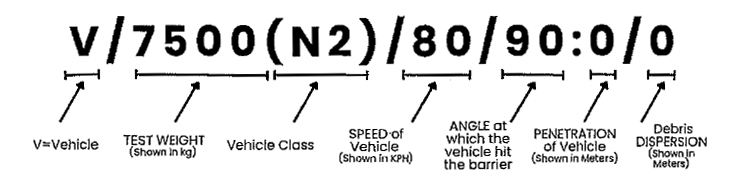
* IWA 14 does not consider debris dispersion.
When Choosing a Crash-Rated Barrier or Gate
The evolution of the crash rating system is confusing. It is easy to find misstatements or misrepresentations. What to look for:
Tested – A barrier can be tested.
- It could have failed the test
- It may not be certified by an accredited independent testing facility
Tested and Certified – Means the gate or barrier was tested to meet one of the standards referenced on the Crash Test Ratings matrix above, and that the test was certified by an accredited independent testing facility.
Engineered Rating – This term means the gate or barrier is designed to pass one of the previously stated crash test standards based on previous testing, engineering calculations and/or modeling. It may not have undergone an actual test. An engineered stamped certification (PE stamp) can be provided to ensure compliance.
Note: The term “Reinforced” implies stronger and more resistant to impact or damage. Don’t be misled by the term. No quantifiable statements can be made unless the barrier is tested or engineered to perform in a certain way.
TYMETAL provides a broad range of certified anti-ram barriers that are suitable for use in the most demanding perimeter security environments, to include military bases, airports, embassies and high security commercial facilities such as energy plants and data centers.