A single-lane vehicle entry point concentrates security challenges into one manageable moment. One vehicle, one decision, one gate. Multi-lane entry zones are an entirely different challenge. The variables multiply, the oversight demands shift, and the design decisions that determine security performance become significantly more complex. For security planners, facility managers, and design teams working through those decisions, understanding what a multi-lane environment specifically requires is the foundation of getting it right.
Why Multi-Lane Entry Zones Demand a Purpose-Built Security Approach
Adding lanes to a vehicle entry zone does not simply scale the security model — it changes it. The risks that emerge in a multi-lane environment are specific to that context, and they need to be addressed through design rather than managed operationally after the fact.
When several vehicles are moving through adjacent lanes simultaneously, officer attention is divided across all of them, making sight lines across the full entry zone partial. An event that would be immediately visible at a single controlled point could go unnoticed in a lane that is not directly in view at that moment. Tailgating becomes harder to catch as vehicle density increases, and the possibility of a coordinated approach across multiple lanes, where simultaneous actors each receive reduced individual scrutiny, is a threat scenario that does not exist in a single-lane environment.
High-volume entry zones also develop a throughput pressure over time that works against verification quality. Queues create operational pressure to keep vehicles moving, and that pressure tends to compress how thoroughly each vehicle is processed. A multi-lane entry zone that does not account for this dynamic will drift toward permissive in daily practice, regardless of how well it was designed on paper. These are structural realities of the multi-lane environment, and the design needs to address them directly.
Physical Layout and Lane Configuration
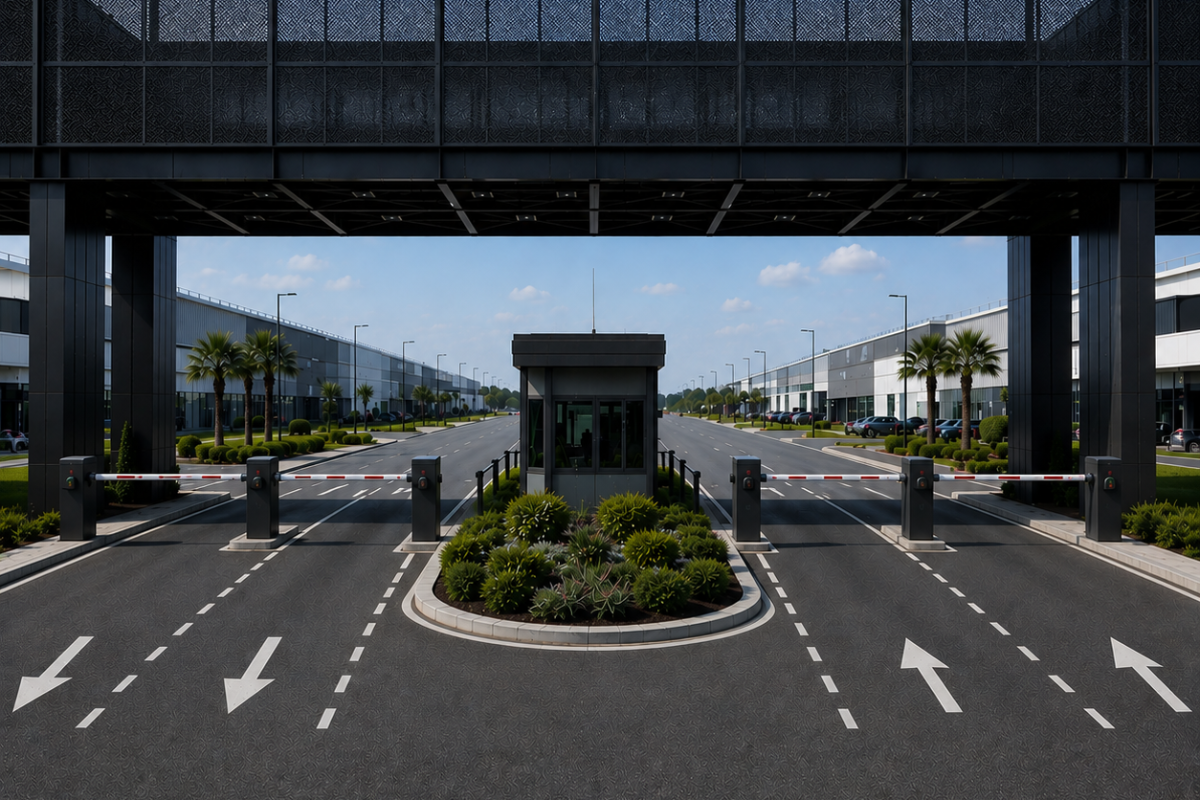
Layout is where security is either set up to succeed or is quietly undermined before a single commercial security gate is installed. Separating inbound and outbound lanes removes a significant source of blind spots. Getting lane width right for the actual vehicle mix that uses each lane prevents clearance compromises that lead to workarounds.
Channelization through islands, bollards, and surface markings keeps vehicle movement predictable and approach angles consistent. These decisions determine what every downstream product and system can realistically deliver.
Threat Assessment Across the Lane Matrix
Employee lanes, visitor lanes, and delivery lanes do not carry the same risk. A dedicated employee lane with pre-credentialed users during set hours creates a different scenario than a visitor lane admitting unknown vehicles or a delivery lane receiving large commercial trucks at variable times. Gate type, operating speed, and protection level should be matched to each lane’s specific use and risk profile, rather than applied uniformly across the zone.
Barrier Placement, Standoff Distance, and the Final Denial Layer
Crash-rated gates, bollards, beams, and perimeter fencing address hostile vehicle risk at the lane level. What determines their effectiveness is not only the product specification but also where they are placed. The final denial barrier needs to sit between the approaching vehicle and the guardhouse. A barrier positioned downstream of the guardhouse does not protect the people working there. Standoff distance, which is the space between the barrier and the protected asset, determines available response time and must be calculated per lane based on actual site geometry.
Guard Coverage, Sight Lines, and Staffing
Guardhouse placement in a multi-lane layout involves tradeoffs that do not exist for a single lane. A central position gives broader coverage but increases travel distance for direct interactions. An end position keeps the officer close to nearby lanes but reduces visibility on the far side. Sight line gaps caused by lane adjacency are structural and need to be addressed through camera and intercom placement at the design stage. The staffing model needs to be determined alongside the layout, not after it, because it directly shapes how much the physical infrastructure needs to do.
Designing the Entry Zone as a System, Not a Series of Gates
Each of those considerations affects the others, which is why they need to be resolved together instead of in sequence. Layout shapes what barriers and gates can achieve. Barrier placement determines whether personnel are protected. Staffing shapes how much the technology needs to compensate.
Zone sequencing is what ties it all together. The queue zone, verification zone, and post-gate holding area each serve a distinct purpose, and gate and barrier sequencing logic, where a vehicle cannot advance until the zone behind it clears, is what makes them function as a coherent system rather than a series of independent gates. That logic has to be designed into the plans from the start.
Build a Multi-Lane Entry Zone That Performs from Day One
Designing a multi-lane vehicle entry zone that performs as intended requires coordinating decisions that affect each other at every stage. Lane configuration shapes what barriers and gates can achieve. Barrier placement determines whether personnel are protected. Staffing and sight line planning determine what the technology needs to support. Zone sequencing holds it all together.
TYMETAL has manufactured security gates, crash-rated barriers, bollards, beams, and perimeter fencing in the United States for more than 35 years. Our product range covers the full scope of what a multi-lane vehicle entry zone requires, from slide gates, lift gates, swing gates, and bifold gates to crash-rated barrier systems designed for specific threat and standoff scenarios. Engaging our team at the site planning and design stage means those product and site decisions can be made together rather than fitted to each other after the fact.
Facilities working through the planning of a multi-lane vehicle entry zone are welcome to reach out early. That is when the conversation is most useful.
Frequently Asked Questions
What makes a multi-lane vehicle entry zone more difficult to secure than a single-lane entry?
Multi-lane entry zones require managing several vehicles moving simultaneously, which divides officer attention and creates partial sight lines across the zone. Tailgating is harder to detect at higher vehicle densities, and the possibility of a coordinated approach across multiple lanes introduces a threat scenario that single-lane environments do not face. High-volume throughput also creates operational pressure that can erode verification quality over time if the design does not account for it.
How should lane layout decisions affect the security design of a multi-lane entry zone?
Physical layout sets the conditions for everything downstream. Separating inbound and outbound lanes removes a significant source of blind spots. Lane width needs to reflect the actual mix of vehicles using each lane to avoid clearance problems that lead to operational workarounds. Channelization through bollards, raised islands, and surface markings keeps vehicle movement predictable and ensures approach angles are consistent for monitoring and detection systems. Layout decisions made at the design stage cannot be fully corrected by technology or products after construction.
Should every lane in a multi-lane entry zone have the same level of barrier protection?
Not necessarily. Employee, visitor, and delivery lanes carry different risk profiles and warrant individual assessment rather than a uniform specification. Applying the same barrier and gate standard across all lanes without considering each lane’s use and threat exposure either over-engineers the lower-risk positions or leaves the higher-risk lanes under-protected. Gate type, operating speed, and crash-rated barrier selection should each be matched to the specific requirements of the lanes they serve.
Where should the final denial barrier be positioned in a multi-lane vehicle entry zone?
The final denial barrier should be positioned between the approaching vehicle and the guardhouse, not downstream of it. A barrier placed on the facility side of the guardhouse does not protect the security personnel working there. Standoff distance, which is the space between the barrier line and the asset being protected, is as important as the barrier’s crash rating and must be calculated for each lane based on actual site geometry rather than assumed from a zone-wide standard.
Why do staffing and guardhouse placement decisions need to be made at the design stage?
In a multi-lane entry zone, guardhouse placement, camera coverage, and staffing model decisions are directly connected to the physical layout. A guardhouse positioned after construction is complete may not provide adequate sight lines across all active lanes. Camera placement added after completion must work around blind spots rather than eliminate them. The staffing model determines how much the physical infrastructure needs to compensate, and that determination needs to inform the layout and technology decisions before they are finalized, not after.