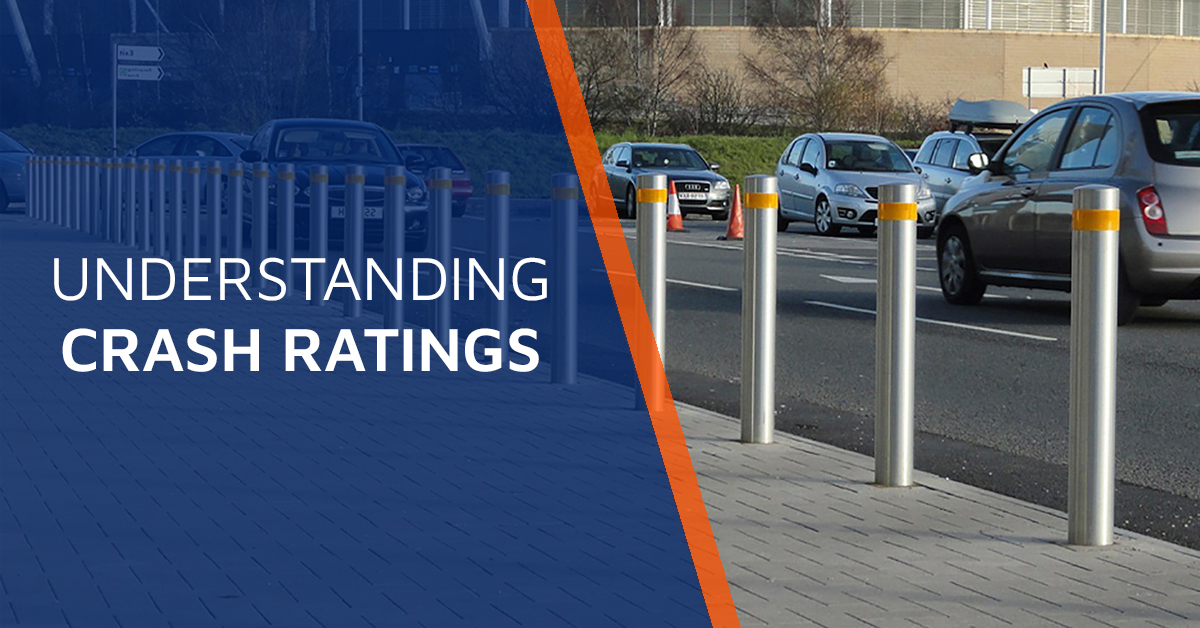
Understanding Crash Ratings
Crash Test Rating Methods
1985: The first barrier test methods were published in 1985 as Standard SD-STD-02.01 by the Department of Diplomatic Security (DDS), the security arm of the Department of State (DOS). The test vehicle was specified as a Medium-Duty Truck weighing 6800 kg (15,000 lbs.). The payload was securely attached to the frame. Nominal impact velocities were 50, 65 and 80 km/h (30, 40 and 50 mph). Penetration limits (upon impact) were 1, 6 and 15 meters [3 (L3), 20 (L2) and 50 (L1) feet], measured from the attack side of the barrier device to the final resting position of the front of the frame of the frame rails of the test vehicle.
2003: The DOS updated Standard SD-STD-02.01 to SD-STD-02.01 Revision A. The revision limited the acceptable penetration distance to the highest level of performance, or 1 meter (3.3 feet). It required a payload of 208-liter (55 gallon) steel drums to be filled with soil, strapped together, and then strapped to the vehicle load platform. In addition, the penetration distance was to be measured from the non-impacted surface of the barrier to the front of the cargo bed, after the vehicle reaches its final position.
2007: Test Method ASTM F2656 was introduced and is the most current US crash test standard. The Department of Defense (DoD)/US Army Corps of Engineers publishes and maintains a list of tested anti-ram vehicular barriers (DoD Anti-Ram Vehicle Barrier List). ASTM F2656 includes the same test vehicle as that described in 2003 (SD-STD-02.01 Revision A) but added additional test vehicles [Small Passenger Car (SC), Full-Size Sedan (FS), etc.]. The Medium-Duty Truck was re-designated Standard Test Truck (M) and additional penetration ratings were re-established (P1, P2 and P3). See below:
- P1 = less than or equal to 1 meter (3.3 feet)
- P2 = 1.01 meters to 7 meters (3.31 feet – 23.0 feet)
- P3 = 7.01 meters to 30 meters (23.1 feet – 98.4 feet)
The Most Commonly Used Crash Test Ratings matrix below further describes the above-described test methods and details how they compare to each other, and to British Standards Institute (BSI) standard PAS 68 and IWA 14.
Most Commonly Used Crash Test Ratings
| Crash Test Standard | US DoS SD-STD-02.01 (1985) | US DoS SD-STD-02.01 Rev. A (2003) | ASTM F2656-20 (2007-current) | BSI (British Standards Institution) – PAS 68 & IWA 14 |
|---|---|---|---|---|
| Test Vehicle | 15,000 lb Medium Duty Truck | 15,000 lb Medium Duty Truck | 15,000 lb Standard Test Truck (M) | PAS 68 – 7,500 kg (16,535 lb) Cab-over Engine Medium Duty Truck IWA 14 – 7,200 kg (15,873 lb) Cab-over Engine Medium Duty Truck |
| Test Vehicle Speed | K4 = 30 mph K8 = 40 mph K12 = 50 mph | K4 = 30 mph K8 = 40 mph K12 = 50 mph | M30 = 30 mph M40 = 40 mph M50 = 50 mph | 48 kph = 30 mph 64 kph = 40 mph 80 kph = 50 mph |
| Penetration Ratings | L3 = less than or equal to 3 ft L2 = greater than 3 ft – 20 ft L1 = greater than 20 ft – 50 ft | Must be less than or equal to 1 m | P1 = less than or equal to 1 m (3.3 ft) P2 = 1.01 m – 7 m (3.31 ft – 23 ft) P3 = 7.01 m – 30 m (23.1 ft – 98.4 ft) | Penetration distance of both vehicle and debris field are given in the classification (see interpretation below). |
| Examples | K12 (L2) – Rated to stop a 15,000 lb truck traveling 50 mph with a penetration between 3 ft and 20 ft. | K4 – Rated to stop a 15,000 lb truck traveling at 30 mph with a penetration of less than or equal to 1 m. | M40 (P3) – Rated to stop a 15,000 lb truck traveling at 40 mph with a penetration between 7.01 m and 30 m. | How to read PAS 68 classification code (see graphic below this table*). |
*Interpreting the PAS 68 Classification Code
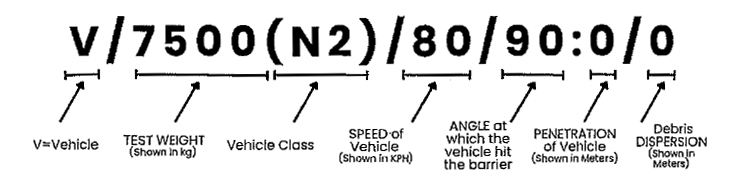
* IWA 14 does not consider debris dispersion.
When Choosing a Crash-Rated Barrier or Gate
The evolution of the crash rating system is confusing. It is easy to find misstatements or misrepresentations. What to look for:
Tested – A barrier can be tested.
- It could have failed the test
- It may not be certified by an accredited independent testing facility
Tested and Certified – Means the gate or barrier was tested to meet one of the standards referenced on the Most Commonly Used Crash Test Ratings matrix above, and that the test was certified by an accredited independent testing facility.
Engineered Rating – This term means the gate or barrier is designed to pass one of the previously stated crash test standards based on previous testing, engineering calculations and/or modeling. It may not have undergone an actual test. An engineered stamped certification (PE stamp) can be provided to ensure compliance.
Note: The term “Reinforced” implies stronger and more resistant to impact or damage. Don’t be misled by the term. No quantifiable statements can be made unless the barrier is tested or engineered to perform in a certain way.
TYMETAL provides a broad range of certified anti-ram barriers that are suitable for use in the most demanding perimeter security environments, such as military bases, airports, embassies and high security commercial facilities such as energy plants and data centers.
Table of Contents:
The 3 Determining Factors | K-Ratings | M-Ratings | Tested vs Certified vs Engineered | ASTM Models and Codes
Bollards and security gates keep entrances secure. They minimize both unauthorized access and property damage during an accidental crash. Security measures involving gates and barriers are vital to modern industry and defense. Standardized, unbiased U.S. crash ratings determine the durability of such security gates.
With these ratings, you can determine which barriers will hold up the best against rams and crashes. If you’re looking for a secure gate or barrier, pay attention to crash ratings. Learn about how to interpret crash ratings for gates and bollards.
The 3 Factors That Determine Crash Ratings
Three basic factors determine crash test ratings:
- The weight of the vehicle
- The speed at which the vehicle is traveling
- The distance the vehicle travels beyond the barrier
Some rating systems only award certification up to a certain number of feet beyond the barrier — anything beyond has not earned certification. Together, these three factors make up the classification for a barrier’s crash rating. You might find crash ratings in terms of K-ratings or M-ratings, so it’s important to know the difference.
K-Ratings vs M-Ratings
K-ratings and M-ratings are both systems that are used to assess the crash resistance of security barriers like bollards, for example. The primary difference between K-ratings and M-ratings is that the certification rating is given based on how far the payload travels past the barrier after impact. Let’s dive into each in a bit more detail.
K-Ratings: Old Ratings
The Department of Defense (DOD) crash ratings, also known as K-ratings, have been around since 1985. Department of Defense ratings are based on how far a 15,000-pound vehicle travels past a barrier at a given speed. When it comes to K-ratings, only vehicles that travel 50 feet or less beyond the barrier earn certification. Increasing K-ratings represent tests at higher speeds, with the same size and type of vehicle. Specific K-ratings on the DOD anti-ram vehicle barrier list include:
- K4 crash ratings: These represent tests at 30 miles per hour.
- K8 crash ratings: This test speed is 40 miles per hour.
- K12 crash ratings: These ratings apply to a test at 50 miles per hour.
K-ratings are further divided into L1, L2, and L3, based on how far the front of the vehicle traveled beyond the barrier.
- L3 rating: The vehicle traveled beyond the barrier less than 3 feet.
- L2 rating: The vehicle traveled beyond the barrier between 3 and 20 feet.
- L1 rating: The vehicle traveled beyond the barrier between 20 and 50 feet.
The strongest barrier, in terms of K-ratings, would be K12: L3 — in this case, a 15,000-pound vehicle moving at 50 miles per hour penetrated the barrier less than 3 feet. When interpreting K-ratings, use the “K” number to determine the test vehicle’s speed and the “L” number to determine how far it traveled beyond the barrier.
M-Ratings: New Ratings
M-ratings have replaced K-ratings in recent years, using standards from the American Society for Testing and Materials (ASTM). ASTM crash ratings are different because they’re based on how far a vehicle’s payload travels beyond a barrier, rather than its front. Like K-ratings, M-ratings are based on vehicle size, speed, and travel distance.
M-ratings are similar to K-ratings in that their numeral designations correspond with test vehicle speeds. You can match K-rated and M-rated tests based on speed. A K4 and M30 rating are equivalent, a K8 rating matches M40, and a K12 rating matches M50. The vehicles in these tests traveled at 30, 40, and 50 miles per hour, in that order. M-ratings and K-ratings are similar enough to be interchangeable.
M-ratings are also divided into P1, P2, P3, and P4 classifications, based on how far the front of the truckbed traveled beyond the barrier:
- P1 rating: A vehicle traveled 3.3 feet or less.
- P2 rating: A vehicle traveled between 3.31 and 23 feet.
- P3 rating: A vehicle traveled between 23.1 and 98.4 feet.
- P4 rating: A vehicle traveled farther than 98.4 feet.
You’ll notice that M-ratings accommodate for farther distances than K-ratings, which can make for a more accurate measure. The equivalent of a K12: L3 rating would be an M50: P1 rating. Meanwhile, an M50: P2 rated beam could withstand a 15,000-pound vehicle moving at 50 miles per hour without allowing it to travel more than 23 feet.
Different ASTM Models and Codes Used
As mentioned above, ASTM uses models and codes to classify anti-ram tests based on vehicle speed, weight and distance traveled. It’s important to be able to decipher these codes if you want to understand crash ratings. Read more about ASTM standards for vehicle security barrier crash tests.
An important element is the speed rating, designated as follows:
- S10: The minimum test velocity is 10 miles per hour.
- S20: The minimum test velocity is 20 miles per hour.
- S30: The minimum test velocity is 30 miles per hour.
Next are the ASTM penetration ratings — how far the vehicle was able to travel beyond the barrier. Penetrations ratings for low-speed tests include:
- P1: At a low speed, a vehicle penetrated the barrier no more than 1 foot.
- P2: At a low speed, a vehicle penetrated the barrier between 1 and 4 feet.
- Failure: At a low speed, a vehicle penetrated the barrier beyond 4 feet.
For high-speed tests, the standards are a bit more forgiving. The codes used to designate high-speed penetration ratings include:
- P1: At a high speed, a vehicle penetrated the barrier no more than 3.3 feet.
- P2: At a high speed, a vehicle penetrated the barrier between 3.31 and 23 feet.
- P3: At a high speed, a vehicle penetrated the barrier between 23 and 98.4 feet.
Words to Look For When Selecting a Crash-Rated Barrier
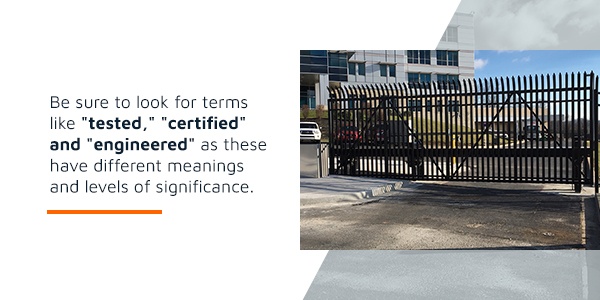
When selecting a barrier or gate, there are additional words to look for alongside the crash ratings. Be sure to look for terms like “tested,” “certified,” and “engineered” as these have different meanings and levels of significance when it comes to crash ratings.
- Tested: Be wary of a “crash-tested” label. Just because a barrier was “tested” does not mean it passed the test or fits the specifications of a label. As misleading as it is, a product labeled “tested” per ASTM 2656 standards at a certain K- or M-rating may not actually meet that rating. The vehicle could have failed the test or it could have a penetration rating of P4.
- Certified: “Certified” is a more accurate label. If a barrier product is ASTM 2656 certified at a particular rating, that means it passed that test, achieved that rating, and has been verified by an independent testing facility. With that, you want to look for ASTM certified barrier products.
- Engineered: If a product is “engineered” to meet a certain label, that means it was designed to pass that test based on calculations or computer models. It may not have undergone actual, real-life testing, so keep that in mind.
When it comes down to it, you’ll want to look for “certified” M-ratings and K-ratings. Inquire further if you see the labels “tested” or “engineered” — ask if tested products met the designated standards, and ask if engineered products ever underwent actual, physical tests. If not, you have little guarantee the products will withstand real-life crashes.
Certified Crash-Rated Security Gates and Barriers From TYMETAL
When security is a top priority, you need crash-rated barriers that meet high standards. At TYMETAL, all of our security gates and crash barriers have achieved prestigious ASTM crash ratings. You can rest assured knowing our barriers have met the universal, unbiased standards of the ASTM. Shop durable crash-rated bollards and in-stock security gates from TYMETAL today.

Reviewed By Chris Herold on 4/29/2021